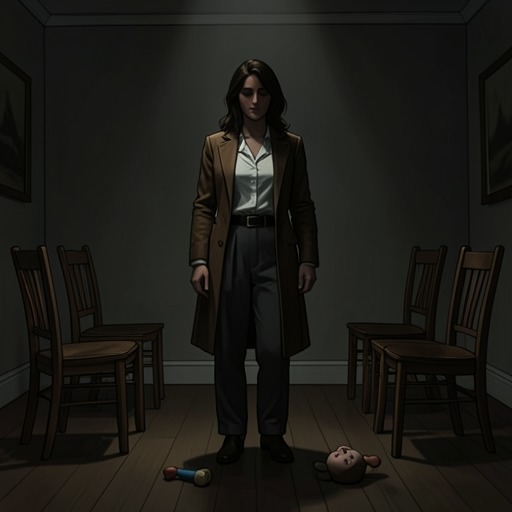
Separation confrontation at the Vermont inn
The Woman in the WindowThe Separation confrontation at the Vermont inn turns a private marital rupture into a decision about what Olivia will be told and when. In a corridor beside a humming ice machine, Anna and Ed move from the possibility of postponing the truth until after Christmas to an exchange of blame that leaves their former intimacy painfully present. The scene’s final action is simple and consequential: they go to tell their daughter.
The corridor and the confrontation
Anna is scooping ice from a machine in the inn corridor when Ed appears beside her. The scene begins in an awkward pause: she pretends not to notice him and keeps gathering the cubes, wishing both that he would leave and that he would hold her. That opposed wish makes the encounter’s emotional stakes visible before either of them speaks. Physical proximity has not restored closeness; Anna is left waiting for Ed to choose whether to withdraw or reach toward her.
The ice gives the silence a bodily edge. Anna’s hands are cold and burning, the cubes stick to her skin, and some have spilled onto the floor. Ed rubs a spot on the bucket as he struggles to speak. The machine continues to thrum between them, a mundane object occupying the space where direct contact might otherwise be. When Ed finally says, “I don’t want to do it this way,” Anna first hears the possibility of reconsideration in his words. Her expectation is that he might have changed his mind, but his next explanation makes clear that the argument is about the terms of their separation, not a retreat from it.
Christmas, timing, and Olivia
Ed objects to the plan of maintaining a happy-family appearance through Christmas and separating the next day. His unfinished sentence—“A whole happy-family holiday, and then the day after Christmas we . . .”—breaks off before he can name what follows. Anna immediately asks whether he wants to tell Olivia now. The question brings their daughter into the corridor’s private confrontation: their disagreement concerns not only their marriage but also the moment at which Olivia will learn that the family arrangement she sees is changing.
Ed’s explanation frames his preference as an attempt to begin healing sooner. He says he thought Anna would want that, invoking what she might advise one of her patients. Anna rejects being told what she would or should say. His appeal to her professional perspective cannot settle the personal question between them; instead, it makes her feel that he is speaking for her while avoiding the sharper statement of his own wishes. When she says that, as far as Olivia knows, there is nothing to heal, the gap between a visible family holiday and the hidden marital crisis becomes explicit.
Blame and the remembered family
Ed tells Anna that he cannot take the situation any longer. His words shift the exchange from a dispute over timing to a judgment about responsibility. Anna responds softly, asking him not to blame her when Olivia is upset. Ed answers directly: “I do blame you.” He then says he once thought of her as “the girl next door,” but that he can barely look at her now. The remembered affection contained in that image is immediately contradicted by his present inability to face her.
Anna’s recollection turns from the inn to a family outing in New Jersey, where she, Ed, and Olivia harvested cranberries. Olivia shrieked and laughed in her waders, sticky with sunblock; Ed’s hands were full, and Anna held their daughter’s fingers as the bog water rose to their hips. The memory is not a general recollection of a happy marriage but a specific scene of shared work, parental closeness, and sensory detail. Its abundance stands against the corridor’s scattered ice and silence. Anna remembers Ed’s dark-brown eyes, which he had called completely ordinary on their second date; she still finds them beautiful. That continuing tenderness does not undo the accusation. It shows what remains emotionally alive for her at the moment their marriage is being named as broken.
Telling Olivia
After the pause, Anna and Ed go to tell Olivia. The scene ends at the threshold of that conversation rather than recounting Olivia’s response, so it establishes their action without supplying an outcome beyond it. Ed’s refusal to stage a happy-family Christmas has become a decision to address the change directly, and Anna’s warning that Olivia may be upset remains unanswered as a practical concern. Their joint movement toward their daughter contrasts with the stillness of the corridor: they have not reconciled, and Ed has explicitly assigned blame, but they leave together to tell her.
As a remembered episode, the confrontation gives the separation a concrete form through its timing dispute, bodily hesitation, and abrupt changes in address—from imagined reconciliation, to practical questions about Olivia, to direct accusation. The ice machine and the cranberry bog hold opposite impressions of the marriage: cold objects and dropped cubes in the present, a vivid family memory in the past. Neither image resolves the rupture. The final movement toward Olivia instead marks the moment when the separation can no longer remain only between Anna and Ed.